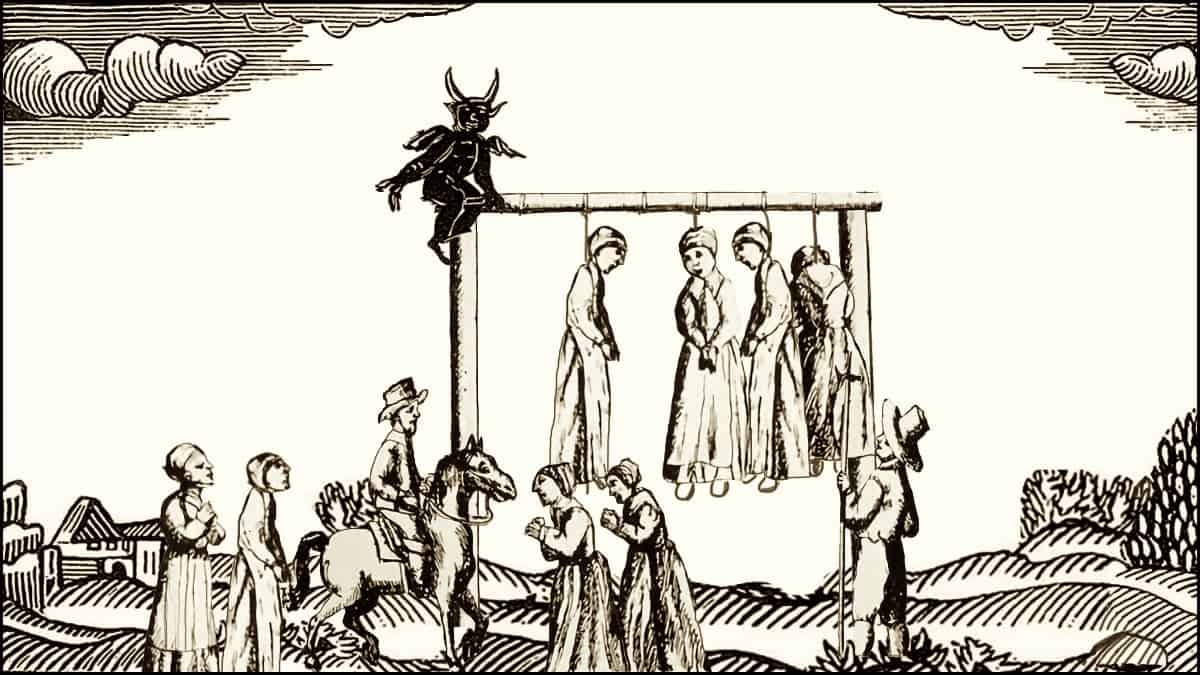
We are heartened to have found a short documentary that memorializes eight women of Manningtree, UK, who were hanged as “witches” following the witch trials at Chelmsford in 1645.
Created by Imogen Simon, the film follows the persecution of these poor women, who were among the first victims of the self-anointed “Witch-finder General”, Matthew Hopkins. It tells the tale of baseless accusation, savage interrogation and, ultimately, the deeply ingrained misogyny of Puritan society that led to their deaths.
The persecution of “witches” had, prior to the 17th Century, been a constant in the assault on women since the rein of the Christian Roman Emperor Constantine. As the Roman religion moved from the worship of numerous deities to Christian monotheism, so too did the consolidation of the power in the new religion shift from a tolerance of local spiritual practices to the outlawing of Paganism.
Church doctrine introduced in later centuries equated Pagan (i.e. non-Christian) spiritualism to that of Satanism under the umbrella term of “witchcraft”. This false equivalence, combined with a desperate need to demonstrate piety and devotion to the Christian triune God, provided a religious justification for the persecution and murder of countless women.
When James I, a public opponent of witchcraft and demonology, ascended the English throne in 1603, the religious permissiveness of witch-finding moved to a more dangerous phase. His Parliament introduced the 1604 statue, An Act against Conjuration, Witchcraft and dealing with evil and wicked spirits, which ruled that women tried as witches should no longer simply be imprisoned, but should be hanged.
Societal Misogyny
Contents
As Imogen Simon argues strongly in her documentary, these eight women of Manningtree were victims of misogyny as much as religious fervor. The highlighting of misogyny is correct and is often overlooked in discussions of witch-trials. Eastern England of the 1640s was a Puritan stronghold, a society in which women were considered culturally inferior to men. It was a culture in which women could be accused so readily of being witches.
Misogyny was a key aspect of court proceedings during this period, as illustrated by the works of Puritan clergyman, Richard Bernard. His books A Guide to Grand Jury Men, Divided in two books, first published in 1627, were created to act as moral guides for the men serving on the jury in witch-trials. They are dripping with misogyny when explaining why “women exceed the men” in the being accused of witchcraft (here translated into Modern English):
1. Satan has set upon [women] rather than on men ever since his unhappy appearance and corruption of Eve
2. [Women] have a more credulous nature, and apt to be misled and deceived.
3. For that [women] are commonly impatient, and more superstitious, and being displeased, more malicious, and so more apt to bitter cursing, and far more revengeful, according to their power, than men, and so herein more fit instruments of the Devil.
4. They are more [talkative], and less able to hide what they know from others, and therefore in this respect, are more ready to be teachers of Witchcraft to others, and to leave [their teachings] to children, servants, or to some others, than men.
5. And lastly, because where [women] think they can command, they are more proud in their rule, and more ready in setting such work on whom they may command, than men. And, therefore, the Devil works mostly to make them Witches: because they, upon every light displeasure, will set him on work, which is that which [Satan] most desires
Richard Bernard (1627) A Guide to Grand Jury Men, Divided in two books.
What Richard Bernard is saying in this diatribe is that because women are more emotional, apt to speak their minds, and instruct men to do things, then the “Devil” is more inclined to turn them into witches.
Hanged in front of their neighbors, family, and friends

Given the entrenched misogyny, together with religious zealotry sanctioned by both Church and State in the 1640s, there was little hope for any woman accused of being a witch. Yet those accusations were but one step in the execution of these women by hanging. Next, was the extraction of a confession of Devil worship.
Confession by torture was illegal in the 1600s, but that did not deter local zealot, Matthew Hopkins, from developing a new technique of interrogation that he called “watching”. As described in Simon’s documentary, this included locking the women in a cell with their aggressive captor. They were made to sit naked on a stool, and were deprived of both sleep and food until they confessed.
It was this new technique of “watching” that was so successful in getting these initial eight women of Manningtree tried for malfeasance. That success led to an explosion of persecution and death, particularly at the hand of Hopkins and his cohorts. It was also this technique of “watching” that led directly to the infamous witch trials of Salem, Massachusetts.
Never before had so many innocent women been executed for the crime of witchcraft, a crime that they – or at least, most – did not commit. The entrenched misogyny of the 17th Century, particularly in Puritan culture, played a lead part in these women’s murders.
Thanks Imogen. Fantastic work and excellent for use with my A Level students.
We are reading debut novel, THE MANNINGTREE WITCHES for our book club this month so it is fascinating a factual account